
Idea, Score, Process, Object

April 9—May 17, 2026
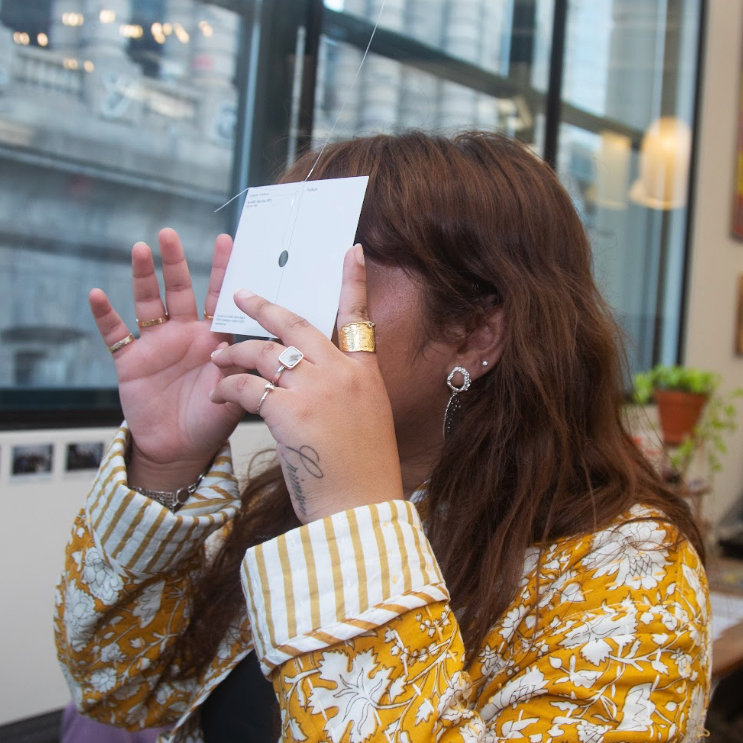
Photos by Hee Eun Chung
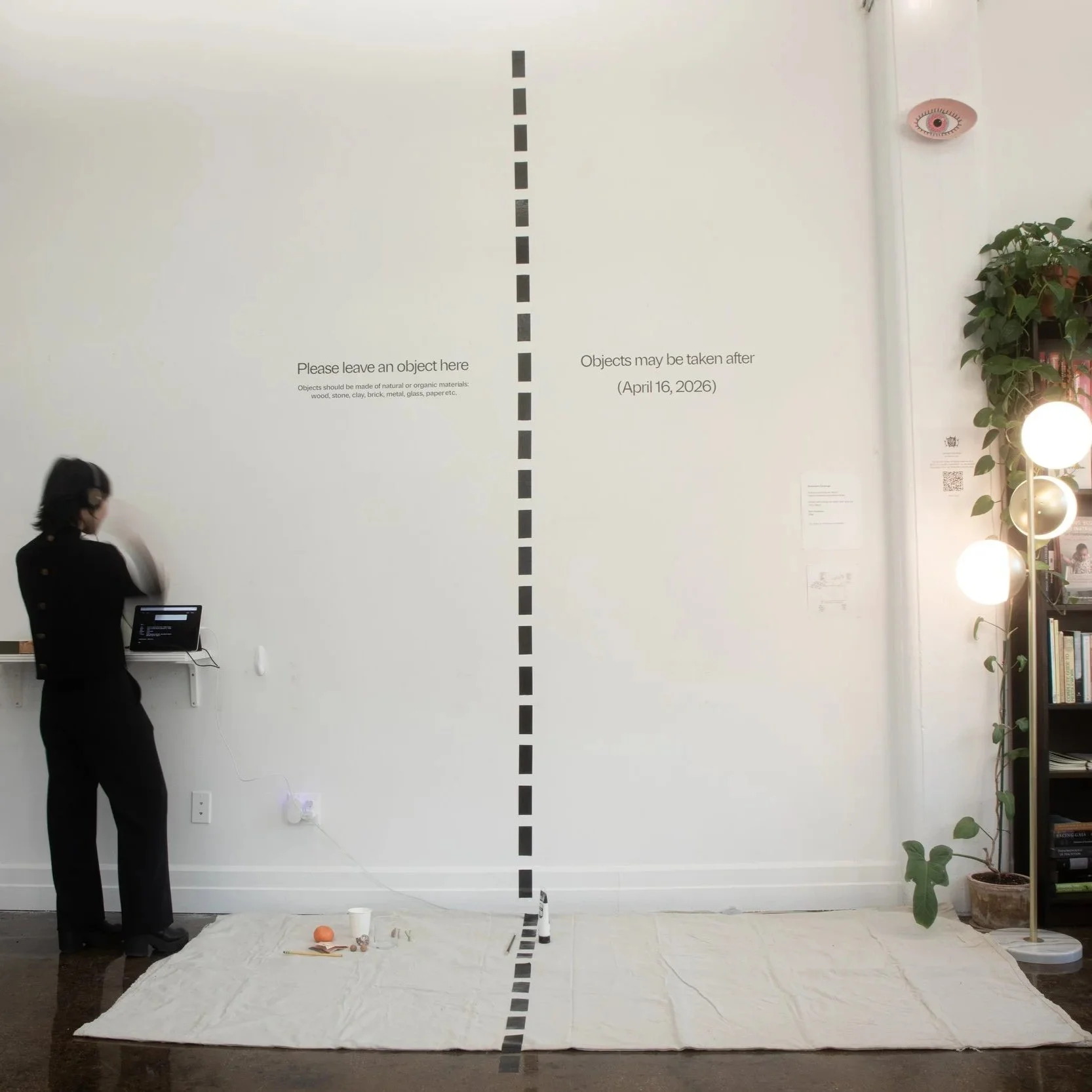
Read full press release HERE.
Attendees at SoRA’s Attention Labs may first approach practice cards as sets of directions, and soon realize that they already contain encouragements of deviation, failure, and reframing. This exhibition spotlights scores, an artistic form that inspired the school’s attention practices and Attensity! Manifesto, in three modalities: action, text/ephemera, and archive. Centering on instructional pieces by original Fluxus artist Ken Friedman—one of which was specially created for the exhibition—alongside The Scores Project archive and ephemera from historical artists, we ask how scores continue to shift our everyday relationship to space and time as they circulate through institutional, commercial, and personal networks.
Ken Friedman introducesa new piece, Not by Carl Andre (2025), a protocol inspired by a question he posed in “The Belgrade Text” (1990) on what can be considered an original “piece” by minimalist artist Carl Andre (1934-2024): what would happen if Andre’s assistant replicated his brick installation with a different set of bricks, and a collector unknowingly acquired the assistant’s version? Now in material form, the brick sculpture at SoRA that is indeed “not by Carl Andre” magnifies the strange dilemma of intentionality in art, and hints at alternative ways of defining artistic experience both for artists and audiences. Also on view is Friedman’s Rotterdam Exchange (1986), open for audience participation during the school’s open hours and DUMBO Open Studios on April 18 and 19, 1-6pm.
We also present The Scores Project: Experimental Notation in Music, Art, Poetry, and Dance, 1950–1975 (web version) courtesy of author and researcher Natilee Harren, a publication co-edited with Michael Gallope and John Hicks and designed by Andrew LeClair and E Roon Kang that offers a comprehensive view of the interdisciplinary experimental practices that exploded in the 1960s by pairing notations with scholarly essays and documentation of their performances. Displayed alongside physical ephemera from George Maciunas, Daniel Spoerri, George Brecht, Yoko Ono, Allan Kaprow, Ben Vautier, Philip Corner & Sean Miller, and Walker Art Center, that can be seen, listened, and grown (Spoerri) anywhere, we encourage viewers to compare different paths through which score-based works may circulate.
Scores are commonly found in notations for music and performance, conveying durational qualities such as pitch, tempo, direction, and even emotional sensibilities that performers would convey. This format found a specific valence in modern and contemporary art movements that encouraged interdisciplinary and process-oriented experimentation. It is not simply the ability to integrate different mediums but its abolishment of the hierarchy and distinction between primary and secondary creators, between original and reenactment, which made the score so potent. Interpretation is not a byproduct but the primary function of scores—in this form, a work of art can exist equally and simultaneously as “an idea, as score, as process, as object” (Ken Friedman, “Belgrade Text,” 1990).
An equally important effect of engaging with a score is its overturning of the status of a work of art as a self-complete object. In portable materials and approachable language —“[promoting] non art reality to be grasped by all peoples, not only critics, dilettants and professionals,” as George Maciunas’ Fluxus Manifesto reads—, scores often uncover previously unnoticed elements in existing objects, environments, or interactions. In this way, they act as primers for similar encounters in our lives, as microcosms of essential questions such as time and space, life and death.
While the scope of our exhibition largely refers to works produced in the 1960s and 1970s, artists nowadays continue to claim new territory for the format, including Raven Chacon, Christine Sun Kim, Ander Mikkalson, and many more. In fact, scores are strikingly elastic in terms of preservation. Even when original materials fade, ideas and codes are passed on—through letters, posters, rare book stores, on Ebay, as a pdf. Especially now at a time when language models continue to accelerate the conversion between image and text, encoding and decoding, they insist that we not take for granted the seemingly automatic link
between form and meaning. In front of a score, we are all interpreters and translators—without the convenience of an authorial voice, wemust exercise our own attention to peel layer after layer of the unassuming yet mysterious object.
About the artists
Ken Friedman is the youngest member of the classical Fluxus group. He had his first solo exhibition in New York in 1966. His work is represented in the Museum of Modern Art, The Whitney Museum, Tate Modern, the Hood Museum of Art at Dartmouth College, and Staatsgalerie Stuttgart. He is president of the Emily Harvey Foundation in New York and Venice. The foundation holds one of the world’s most prominent collections of work by Fluxus artists.
Natilee Harren is a scholar and critic of modern and contemporary art and theory, with particular focus on the conceptual and material entanglements of experimental, interdisciplinary practices after 1960. She is an assistant professor of modern and contemporary art history at the University of Houston.
Organized by the Strother School of Radical Attention
Resident Curator: Haena Chu
Artists: Ken Friedman; Scores Project editors Natilee Harren, Michael Gallope, John Hicks and designers Andrew LeClair and E Roon Kang; ephemera from George Brecht, Eleanor Coppola, Philip Corner & Sean Miller, ESTAR/SER, Allan Kaprow, George Maciunas, Yoko Ono, Daniel Spoerri, Ben Vautier.