
“World on a Wire,” Brandon’s movie memory, Wordpress.
World on a Wire
You are driving a truck through the city, watching the blurred lights stretch past you like a sped-up video. The word zurückkommen (come back) is whispered into your ear, and you jolt awake on a plastic bed at the IKZ, the Institute for Cybernetics and Futurology, where you are watching your avatar on a television. Then there’s YOU (the reader!), watching this on a screen in Rainer Fassbinder’s tv series World on a Wire (1973)...
The simulation trope spans far and wide in science fiction. The novel that inspired Fassbinder’s film, Daniel F. Galouye’s Simulacron-3, dates to 1964. Now in 2025, in the shadow of Solaris, Ghost in the Shell, and The Matrix, a plot twist revealing some kind of dream or infra-reality is so familiar as to be expected. You know it's coming; that's how reality works.
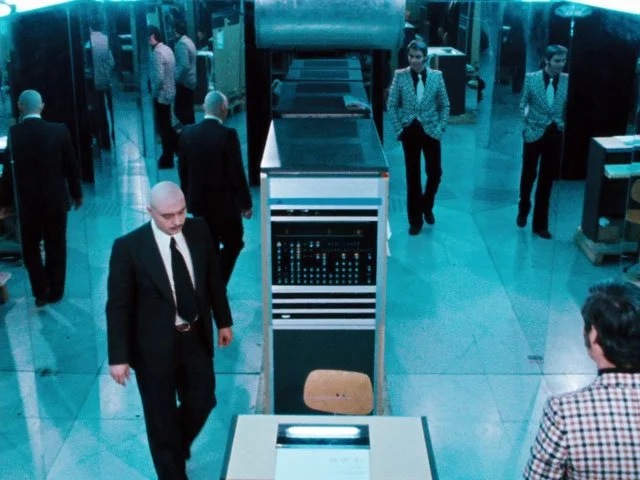
Indeed, the genre itself has, in a funny, recursive move, come to resemble Jean Baudrillard's notion of the simulacrum, which represents the very nature of a duplicated and alienated reality through mise en abyme, or an infinity mirror effect. In World on a Wire, mirrors and screens appear throughout the film, visualizing the behavior of simulacra that refract and dissipate our attention at the level of raw perception. Even the interior design of the film's corporate office, dominated by glimmering metal and plastic surfaces, hovers indefinitely between the material and non-material. At the end of the first episode, World on a Wire discloses the disappointingly mundane truth that its simulacrum was built by a corporation to model consumer behavior and test new products. Sound familiar?
With more than 40 years of simulacral films behind us, the question feels increasingly urgent: can these films inspire new acts of resistance against manufactured truths, or do they rebrand our jaded acceptance as fantasies — and only fantasies — of escape?