

Resurfacing Ruins
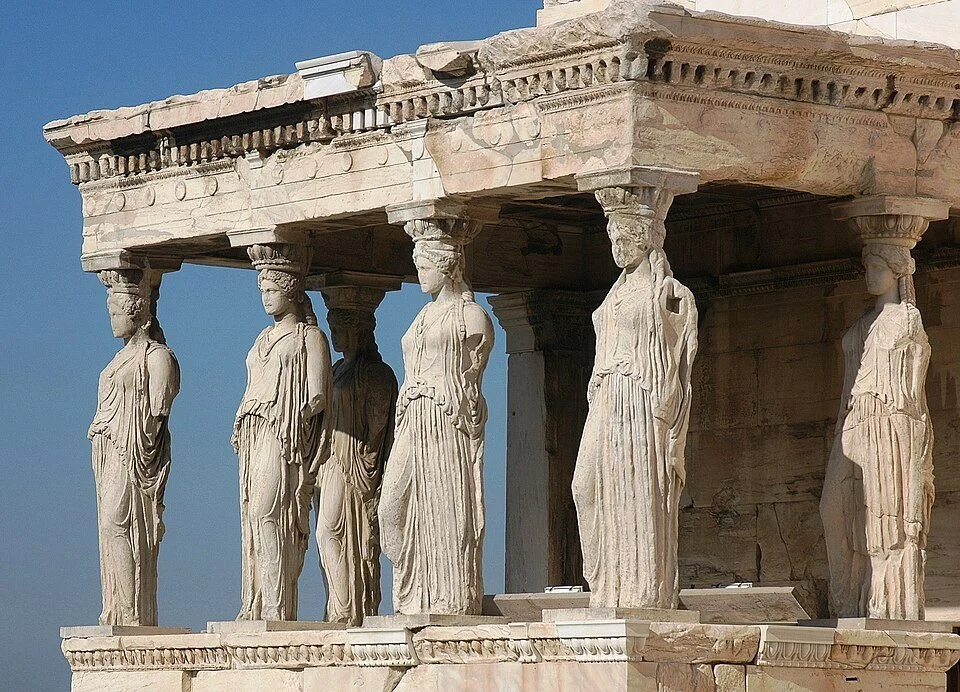
Athènes : les Caryatides sur l'Acropole. Photo prise par Harrieta171 le 21/01/06 (Translation: Athens: the Caryatides on the Acropolis. Photo taken by Harrieta171 on 01/21/2006).
The roof of the Erechtheion, one of four ancient structures on the Acropolis of Athens, is held aloft by six Caryatids: statues of draped maidens standing over six feet tall. These marble figures are modern-day replicas (perhaps unsurprising given the originals were carved nearly 3,000 years ago, around 421–406 BCE). In 1979, Greek authorities removed the statues to protect them from pollution. Five now reside in the Acropolis Museum just down the hill; the sixth, stolen by Lord Elgin in the early 1800s, remains in the British Museum.
This effort to preserve an original is hardly original — countless ancient works have been relocated indoors as humans uncover and tend to the remnants of our own past. Yet the replica Caryatids exhibit none of the freshly-chiseled glory of the originals' antiquity. Rather, they resemble the statues as they were at the moment of their removal: stained, damaged, and incomplete. Why reconstruct ruins rather than recreate what once was? Why enshrine monuments in our present to the ruins of our past?
The Acropolis has lived many lives. Today’s restorations prioritize structural safety over aesthetic wholeness, yet they still source marble from the same quarry used for millennia — a continuous vein of stone running through time. It's a reminder that histories are not static repositories but active shapers of the present (just as the present actively shapes the past). Every restoration makes a choice about what kind of past to deliver into the present — whether a fantasy, a correction, or an obfuscation.
From museum vitrines to full-scale replicas (check out Nashville’s full-sized Parthenon), the ways we attend to these records of humanity reveal as much about us as they reveal about antiquity. In excavating and preserving what remains, we also reify the dynamics — sometimes reverent, sometimes extractive — of the attention with which we memorialize the past.
— Eleanor Lambert