
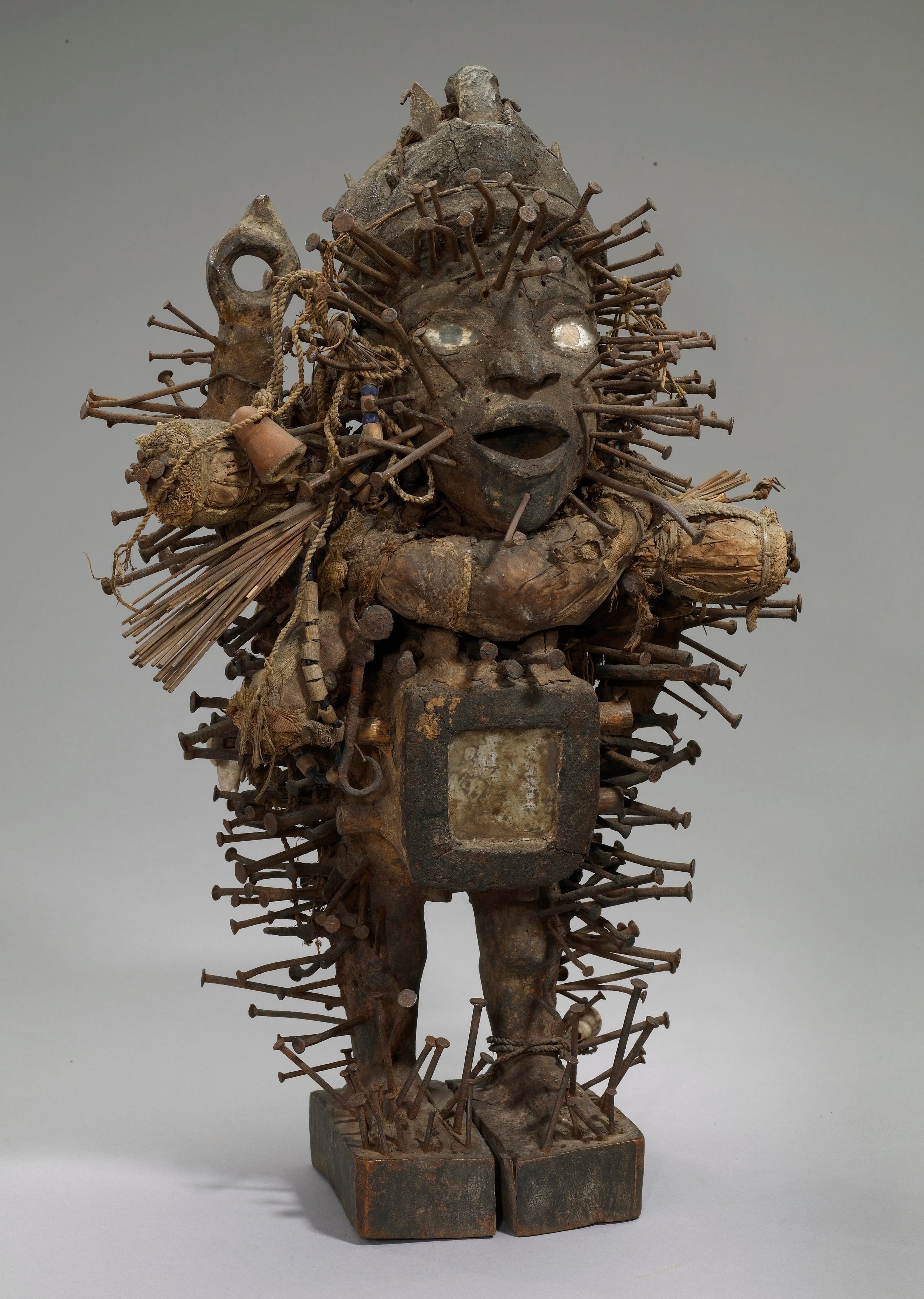
Power figure, early 20th century, Kongo, Wood, natural fibers, glass, metal, undetermined materials, The Christina N. and Swan J. Turnblad Memorial Fund. Image from the Minneapolis Museum of Art.
Vessels of Spirit
From Marx’s commodity fetishism to Freud’s study on object-based fixation, the term “fetish” is understood in much of modern social theory as the investment of animate qualities in inanimate objects. Its origin is a term given by Portuguese colonists to refer to spiritual objects in West Africa such as the Nkisi (plural: minkisi) from modern-day Congo. These minkisi's apparently visceral powers are easily discerned: it's hard to look at the exaggerated facial features and the profusion of nails and blades without feeling a twinge of sensation in one's own skin.
The insertion of these sharp objects was, according to the Kongo people, the source and signal of its animate potency. But understanding minikisi solely in the realm of spirituality obscures their practical social function in maintaining justice and cohesion: they were often deployed to treat both bodily and social illnesses. Perhaps counterintuitively, the insertion of sharp objects does not signal violence; rather, the holes functioned as channels for the spirits dwelling within minkisi to dispense peace or punishment, or to ratify an oath. Nor were these figures “idols,” as early Europeans alleged; the minkisi objects were not equated to any specific god or spirit. What they were, and continue to be, is testament that the points of sensory access between the inner body and the outer world are what gives a being its vitality. This is where the spirit happens.
- Haena Chu