
 Image 1 of 1
Brian Eno famously claimed his 1979 album Music for Airports to be “as ignorable as it is interesting.” Eno was hardly the first to make music meant to create an environment rather than engage a listener. Telemann’s Musique de Table, Erik Satie’s “furniture music,” early 20th-century Muzak, and Japan’s 1980s “environmental music” all reveal a long lineage of composers using sound to contour experience—often unconsciously. What do these practices tell us about how sound organizes our sense of space and, as a result, our attention?
This course explores ambient music as a technology of attention. We’ll listen closely to how these works are constructed, how they unfold through time, and how they reorient (or disorient) our bodies and minds. What does music do when it isn’t asking to be “listened to”?
We’ll spend time with composers such as Brian Eno, Harold Budd, and Hiroshi Yoshimura, and students of all musical backgrounds (no experience necessary) will be invited to experiment with improvisation and composition using laptops, instruments, and voice.
Led by performance artist-composer Nicholas Miller and musician Julie Hill.
Tuesdays, 6:45 - 9:15pm EST
March 3rd-17th
Our courses cost $250, with an Advanced rate for students with an income above 100k. We also offer a Discounted rate for students with constraining circumstances.
Please see our Refund Policy HERE.
Additionally, we offer three tuition-waiver scholarships per course. To apply for a scholarship, click HERE.
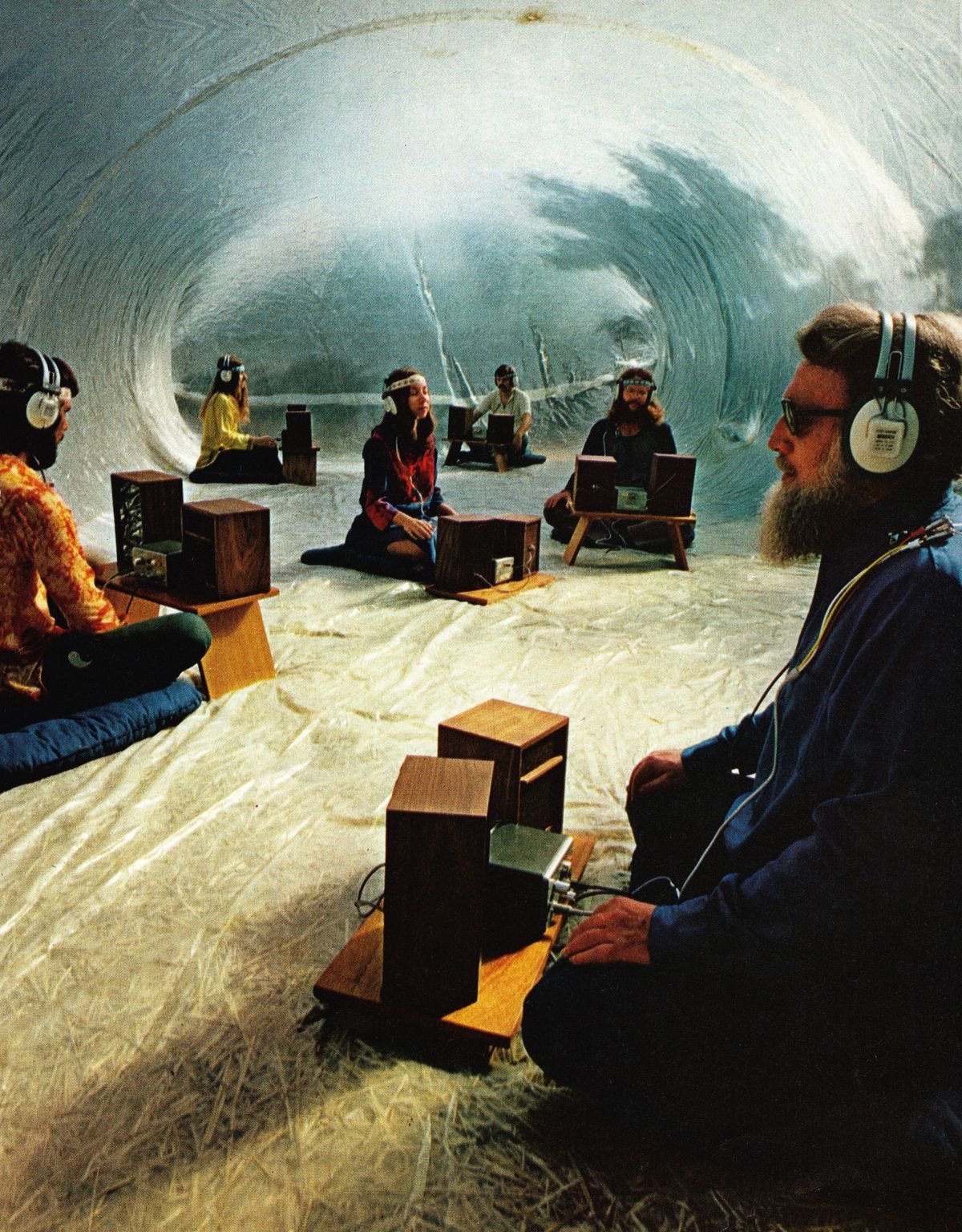
Photo credit: “How to turn off a tension headache”, Gerald Jonas, 1972
Brian Eno famously claimed his 1979 album Music for Airports to be “as ignorable as it is interesting.” Eno was hardly the first to make music meant to create an environment rather than engage a listener. Telemann’s Musique de Table, Erik Satie’s “furniture music,” early 20th-century Muzak, and Japan’s 1980s “environmental music” all reveal a long lineage of composers using sound to contour experience—often unconsciously. What do these practices tell us about how sound organizes our sense of space and, as a result, our attention?
This course explores ambient music as a technology of attention. We’ll listen closely to how these works are constructed, how they unfold through time, and how they reorient (or disorient) our bodies and minds. What does music do when it isn’t asking to be “listened to”?
We’ll spend time with composers such as Brian Eno, Harold Budd, and Hiroshi Yoshimura, and students of all musical backgrounds (no experience necessary) will be invited to experiment with improvisation and composition using laptops, instruments, and voice.
Led by performance artist-composer Nicholas Miller and musician Julie Hill.
Tuesdays, 6:45 - 9:15pm EST
March 3rd-17th
Our courses cost $250, with an Advanced rate for students with an income above 100k. We also offer a Discounted rate for students with constraining circumstances.
Please see our Refund Policy HERE.
Additionally, we offer three tuition-waiver scholarships per course. To apply for a scholarship, click HERE.
Photo credit: “How to turn off a tension headache”, Gerald Jonas, 1972